Another Cycladic Head, Another Curious Provenance

Around 18 months ago I wrote a piece examining the reported provenance for a Cycladic head sold through Christie’s New York in April 2022. According to the information supplied by Christie’s, the head was initially owned by the Swiss antiquities dealer Heidi Vollmoeller who acquired it in the 1960s. Vollmoeller held the head for roughly the next 15-20 years, until it was sold to the Merrin Gallery in New York in the 1980s (and then onto other anonymous owners). Unsurprisingly, however, I found issues with this provenance offered, and suggested that it had at least been partially fabricated and that the head was likely owned by the dealer Nicolas Koutoulakis.

Following that blog piece going live, Judith Barr kindly drew my attention to an addendum published by Pat Getz-Gentle (née Getz-Preziosi) in 2008. In this, Getz-Gentle reveals that she had additional background for 104 Cycladic figurines (or parts of figurines) that were included in Peggy Sotirakopoulou’s ‘The “Keros Hoard”: Myth or Reality?’ Using the designations A-1, A-2, A-3, B, and C, Getz-Gentle provides, in descending levels of certainty, additional provenance information for these figurines based on records available only to her, to reinforce her belief that these pieces belong to the so-called ‘Keros Hoard’.

Within this ‘addendum’ the head sold by Christie’s in 2022 (no. 156 in Sotirakopoulou 2005) is assigned by Getz-Gentle to her A-1 category. According to Getz-Gentle, figurines in this category were “identified as belonging to the [Keros] hoard that I saw on visits to N. Koutoulakis from 1968 through 1983. I have photographs of these pieces that I took myself or that were sent to me, at my request, by Koutoulakis.” Without information to the contrary, then, it appears certain that this head was in the possession of Koutoulakis (as hypothesised) at least as late as 1968 and this information was conveniently left out of the provenance provided by Christie’s. With this new information, one wonders just how reliable the remaining provenance is …

Following this discovery, I began to look for other heads from Cycladic figures sold in recent years by Christie’s. In doing so, I came across one (lot 27: of the Early Spedos type) put up for auction on the 8th of December, 2021 (fig. 1: sold for £22,500). As with the head discussed in the previous post, this piece also has a curious provenance. According to the listing, this Cycladic head was part of the infamous Erlenmeyer collection “as per [the] 1970 invoice”; it was then sold to the dealer Ugo Donati in 1970 (note the pre-1972 provenance), and then at some point acquired by Dr Giancarlo Ligabue. Presented, here, is a seemingly clear custody chain, supposedly with supporting documentation (not that it is made available on the listing), that establishes clearly that the head was circulating the market prior to 1970 when Marie-Louis Erlenmeyer apparently parted ways with it.

Figure 1: Cycladic Head. Lot 27. Christie’s Antiquities Auction, 8 December, 2021.

Yet some points require clarification. First, it is well-established that the Erlenmeyers bought their Cycladic material from the aforementioned dealer Nicolas Koutoulakis. Assuming this holds true here, there is, then, at least one link missing from this provenance chain. Secondly, the link with the Erlenmeyer collection is odd. That the Erlenmeyers collected Cycladic material is well-known, and it is frequently noted in publications that they acquired a large portion of the problematic ‘Keros Hoard’ when it first began to surface (see, for example, Sotirakopoulou 2008). This material was apparently acquired in the mid-1950s from Koutoulakis, and studied between 1968 and 1975 by Pat Getz-Gentle (née Getz-Preziosi)*. In a 2008 article, Getz-Gentle (p.300) recounts her first impressions of the Erlenmeyer collection noting that “Although this material included several interesting works, for the most part it was composed of the sort of bits and pieces, of scholarly interest only, that Koutoulakis was happy to dispose of. There were few heads and no fragments of unusually large works” (emphasis mine). It seems odd that a head, particularly when uncommon within the collection, would have escaped Getz-Gentle’s notice. Even if one accepts that Getz-Gentle missed the head and Marie-Louis Erlenmeyer sold it in 1970, it is still seems odd that it was not brought to the attention of Getz-Gentle in her subsequent visits to see the Erlenmeyer collection.

That the head is unpublished is also odd—this remains true even if we ignore its absence from Getz-Gentle’s works. The Erlenmeyers were clearly proud of their collection and on several occasions published parts of it themselves. In 1965, five years before the head in question was supposedly sold to Donati, they published Von der frühen Bildkunst der Kykladen, which featured several of the more valuable pieces of Cycladic sculpture they owned. This included two heads, several largely complete bodies, and the one almost complete figurine, all of which were kept in the collection until Marie-Louise Erlenmeyer eventually sold them through Sotheby’s in 1990 (the heads were lots 135 & 136). Noticeably absent from this publication is the head sold through Christie’s in 2021. In fact, the Christie’s auction, as far as I can tell, is the first time this head has surfaced, let alone been associated with the Erlenmeyer Collection.

The link with Ugo Donati deserves further mention too. A quick search on Google tells us that Ugo Donati died in 1967, three years before he supposedly acquired this piece from the Erlenmeyer collection. It seems likely that what is really being referred to here is the antiquities dealership that was owned by Donati, Donati Arte Classica, which continued to operate after his death. If this is the case, then Christie’s reference to ‘Ugo Donati’ may be a simple typo. However, other antiquities sold through Christie’s, and other auction houses, have been accompanied by provenances that included Donati and made this distinction clear. In October of 2019, a terracotta head was sold through Christie’s and the provenance notes that, at some point (no dates are provided), the sculpture was “with Donati, Arte Classica, Lugano.” Likewise, in July last year (2023), a pair of legs from a Cycladic figurine, were sold through Christie’s and apparently were once “with Pino Donati, Arte Classica, Lugano, September 1970” before being purchased by “Dr Giancarlo Ligabue (1931-2015),” from whom the seller acquired them (given the provenance for the head, this provenance also raises questions: for example, did Pino Donati also acquire the legs from the Erlenmeyers?). If the reference to Ugo Donati for our Cycladic head is just a simple typo, then it serves as yet another reminder of the lack of care auction houses frequently give to provenances.

Of course, it is possible that the head sold through Christie’s was sold by Marie-Louis Erlenmeyer in 1970. If this head did indeed come from the Erlenmeyer collection, then this has potential implications for our understanding of the so-called ‘Keros Hoard’ and its modern history. It suggests that the Erlenmeyer collection was larger (by at least one head) than previously thought and perhaps held more significant sculptural fragments than the “bits and pieces” Getz-Gentle saw. If this is true, then one wonders how much larger this collection was and if any other pieces were sold off by the Erlenmeyers prior to the famous 1990 auction of part of their collection at Sotheby’s. Moreover, inclusion in the Erlenmeyer collection is often used as a justification of sorts for including Cycladic sculptures in the problematic assemblage of material labelled ‘the Keros Hoard’. If this head did come from the Erlenmeyer Collection, then one wonders if it was once part of the corpus of material the Erlenmeyers purchased from Koutoulakis. If so, should it also be considered part of the Keros Hoard? Should this be the case, then it would seem that the hoard, the size and veracity of which is still debated (e.g. see the three articles discussing the hoard in the AJA volume 112.2, 2008), is larger than previously thought. Unfortunately, however, once again, due to a lack of market transparency, we are left in the dark. Without the opportunity to consider the documentation that supposedly supports the provenance provided by Christie’s (and rule out the possibility of forgery à la Getty Kouros (or any number of other equally fitting examples)), or the extensive photo archive Getz-Gentle possesses, these issues will likely never be resolved.

Richard Bott (@RichardBott7)

*In a chapter published in 1983 (The ‘Keros Hoard’: Introduction to an Early Cycladic Enigma p.37), Getz-Gentle claimed that she was first able to study the Erlenmeyer collection in 1975: “In 1968 I made a rapid survey of some 70 figure fragments still in the hands of the original owner[, Koutoulakis]. In 1975 when I returned for a more thorough study of the group I was shown an additional 97 pieces. That part of the material in the Erlenmeyer Collection, numbering roughly 140 pieces, I was also able to study in 1975.” Later, however, in the article from 2008 (p.300), she stated that “I also met Marie-Louise Erlenmeyer (now deceased) in 1968 and was able then, and on several later occasions, to examine the part of the [Keros] hoard that she and her late husband had acquired from Koutoulakis.” Why she reports two widely different points of examination is unknown.

**Unfortunately, a full copy Sotirakopoulou’s excellent monograph, The Keros Hoard”: Myth or Reality? Searching for the Lost Pieces of a Puzzle, is not freely available online. Likewise, I was unable to find an openly accessible version of Getz-Gentle’s aforementioned chapter, ‘The ‘Keros Hoard’: Introduction to an Early Cycladic Enigma’. In Antidoron: Festschrift für Jürgen Thimme zum 65. Geburtstag am 26. September 1982, edited by D. Metzler, B. Otto, & C. Müller-Wirth (pp.37-44).

Cycladic Heads, Christie’s, and Problematic Provenance

In this post, Forging Antiquity Team member and Macquarie University PhD candidate Richard Bott examines a catalogue of antiquities recently offered for sale.

During an auction held in April of this year (2022) in New York, Christie’s sold the head from a Cycladic figurine, of the early Spedos type, for $252,000 USD. While this, in and of itself, is rather unremarkable—an unfortunately large volume of Cycladic figurines were looted in the 20th century and now circulate that antiquities trade, some fetching similarly high prices—the provided provenance (ownership history) is rather interesting. According to the provenance supplied by Christie’s, this piece was supposedly owned first by the Swiss antiquities dealer Heidi Vollmoeller, who acquired it sometime in the 1960s; then by the Merrin Gallery of New York, who acquired it from Vollmoeller in the 1980s; then by a private Canadian collector who purchased it in 1990; and then it was acquired in 2015 by the unnamed individual who sold it through Christie’s: the current owner remains unknown. Further investigation, however, suggests not all is right with this narrative.

Along with the ownership history, the listing for this head draws attention to its publication history, having first surfaced in a 1984 article by Pat Getz-Preziosi. In this article, the head features only briefly appearing in a picture with 17 other heads as stylistic comparisons for the sculptures that form the article’s primary focus.

Left: Screenshot from Getz-Preziosi’s 1984 Nine Fragments of Early Cycladic Sculpture in Southern California, pg. 7 (original figure caption included). Head from Christie’s auction top row, second from right, circled. Right: Head sold at auction by Christie’s.

Unfortunately, but perhaps unsurprisingly, the identity of the then owner of the head (and the other 17) was unreported by Getz-Preziosi. The reader is informed only that these heads are all part of a single “Private collection” and the photo was provided by the collector. However, given the date of the article and the (albeit somewhat unclear) ownership history provided in the auction this year, two options now present themselves. According to the provenance provided by Christie’s, the private collector Getz-Preziosi mentions must be either Heidi Vollmoeller (Galerie Heidi Vollmoeller) or Edward Merrin (Merrin Gallery).

If one begins by assuming that these figures are indeed valid links in the provenance chain, the question becomes why would they, established dealers, wish to remain anonymous? After all, publication and associated effective guarantee of authenticity can sometimes increase the value of an antiquity. One possible explanation can be found in David Gill and Christopher Chippindale’s influential 1993 paper, Material and Intellectual Consequences of Esteem for Cycladic Figurines*. According to Gill and Chippindale (pg. 634), some dealers, like Vollmoeller, held onto Cycladic material for over a decade to ensure a constant, but controlled stream of material entering the market. While this might explain why a dealer would remain anonymous in publication—allowing material to be published drives up value and provides a guarantee of authenticity, while obscuring one’s identity means a piece can enter the market whenever the dealer decides—there are peculiarities with this narrative worthy of further consideration.

In 1976 an exhibition of Cycladic material was held at the State Museum of Baden (Badisches Landesmuseum), in Karlsruhe, Germany. One of those who publicly lent material was none other than Heidi Vollmoeller: some of Vollmoeller’s material was then offered for sale at the 1989 Basel art fair (Gill & Chippindale 1993, 634). Why Vollmoeller would be comfortable publicly disclosing that she owned material in an exhibition but not in a publication seems odd. Similar unusual circumstances surround the supposed ownership of the head by the Merrin Gallery. In 1989, the Merrin Gallery ran an exhibition entitled Masterpieces of Cycladic Art from Private Collections, Museums, and the Merrin Gallery. Interestingly, in the associated exhibition catalogue, which features colour photographs of 27 objects, the head supposedly then owned by the Merrin Gallery does not feature. As this would have been an excellent venue to publicise a sculpture that was presumably available for sale (it was supposedly sold the year after to an unnamed Canadian collector) the absence of the head is rather surprising. While dealers do sometimes obscure their association with certain antiquities, that both dealers featured in this provenance chain were willing to publicly demonstrate they owned other, related Cycladic material while hiding their association with the Christie’s head seems odd.

A more substantial issue with the offered provenance arises when one begins searching for the other heads featured in the 1984 photograph: a third possible, and seemingly more likely, owner emerges. Since 2019 at least three more of the heads from the photograph were offered for sale. First, in May of 2019, the head in the bottom right corner of the 1984 photo was offered for sale through the Artemis Gallery. Secondly, in July of 2019, the head in the middle row, third from right was offered for sale through Christie’s. Finally, in May of 2021, the head in the top right-hand corner was put up for sale through Lyon and Turnbull.

Clockwise from top left: Screenshot from Getz-Perziosi’s 1984 article with sold heads circled. Head sold by Artemis Gallery in May of 2019. Head sold at Christie’s in July of 2019. Head sold Lyon and Turnbull in May of 2021. Colour photos are screenshots taken from the respective auction websites, with the exception of the Artemis Gallery Cycladic head which was taken from an archived version of the auction from ‘the-saleroom.com’.

Of these three pieces of Cycladic sculpture, two (those sold in 2019) feature provenances that clearly contradict the provenance that accompanied the head sold in April of this year (the reported provenance for the third head only states it came from a private Swiss collection and was acquired in 1992). According to the reported provenances, both heads sold in 2019 were in the possession of the dealer Nicolas Koutoulakis up until his death in 1996 (the head sold through the Artemis Gallery states that Koutoulakis acquired it in the 1960s and no acquisition date is given for the other head sold through Christie’s). Given that the 1984 Getz-Preziosi article states that the photo in which all four head feature contains material from a single private collection, it would appear that these heads were owned initially not by Heidi Vollmoeller, but by Koutoulakis.

Further circumstantial evidence supporting the Koutoulakis narrative can be found in a 2008 article by Getz-Gentle (née Getz-Preziosi). Here, Getz-Gentle states that Koutoulakis was the primary dealer in material from the infamous ‘Keros Hoard’ and responsible for supplying other dealers and collectors, that he “exhibited [material] anonymously in Karlsruhe in 1976” (emphasis mine), and that he “had proper photographs taken” after meeting Getz-Gentle in 1968 (2008, 300-304). These additional details suggest that Koutoulakis had access to a large volume of Cycladic material, had a good enough relationship with Getz-Preziosi to provide “proper photographs,” and that while happy displaying his material publicly he preferred to remain anonymous. While none of this proves a definitive link, it certainly does reinforce the suggestion that Koutoulakis had ownership of the Christie’s head.

         If one accepts now that head offered for sale by Christie’s in April of 2022 was owned by Nicolas Koutoulakis at some point, why then was this fact hidden? After all, it was clearly outside of Greece by at least 1984 and, given that it was offered for sale at Christie’s in New York, it could legally have entered the US according to current US law. Well, according to Getz-Gentle (2008, 303), “current dealers and collectors are made nervous by evidence that Keros was indeed the source,” presumably because of the well-publicised looting that occurred there during the mid-20th century. Given that the majority of what is now referred to as ‘Keros Hoard’, of which the Christie’s head is part of, is thought to have gone through Koutoulakis’ hands it makes some degree of sense that the seller may want to obscure this association. Moreover, Koutoulakis is notorious for his role in the sale of looted antiquities, featuring in the famous ‘Organigram,’ which detailed the flow of looted antiquities from Italy. With pressure increasing in recent years for those who now hold looted antiquities that passed through Koutoulakis to return them, it is certainly possible that the seller of the Christie’s head wanted to hide Koutoulakis’ involvement. After all, $252,000 is hardly an insignificant amount of money. Admittedly, it is difficult to place too much faith in one provenance narrative over the other given that none is presented with verifiable support. While the cumulative weight of evidence does suggest that Heidi Vollmoeller did not own the Cycladic head sold at Christie’s earlier this year, without further evidence the exact provenance of the Christie’s head remains unclear. Even if Koutoulakis did own the head, this does not clarify the later narrative: after all, it is entirely possible that Merrin (who also has a history of dealing in looted antiquities) acquired the head from Koutoulakis in the 1980s and then sold it to an unknown Canadian. Likewise, no matter how unlikely it may seem, it is still possible that Vollmoeller was also involved somehow. The only way to avoid these confusing provenance webs is with greater transparency from all involved: the auction houses and dealers who sell these works, the collectors who buy them, and those who continue to willingly publish them with hidden provenances. In this case, one thing is, however, clear. At some point, someone has obscured the provenance for at least one of these sculptures.

Richard Bott (@RichardBott7)

*Unfortunately, it appears the 1993 article by Gill and Chippindale is not open access. All other works noted in this article are available through the hyperlinks provided. 

Cuneiform Tablets in the Ancient Word Catalogue

In this post, Forging Antiquity Team member and Macquarie University PhD Richard Bott examines a catalogue of antiquities recently offered for sale.

In early March, Roberta Mazza shared via her blog and Twitter two brochures, titled The Ancient Word, featuring a collection of manuscripts and inscribed antiquities offered for sale by a Brandon Witt. According to the final page of the larger brochure (and seemingly the first to have been produced) the collection, comprised of 30 antiquities, has an estimated value of $45 million (presumably USD). As will be unsurprising to those familiar with the antiquities trade, the antiquities offered in these two catalogues are largely unprovenanced (lacking prior ownership information) and when provenance is offered it is lacking to say the least.

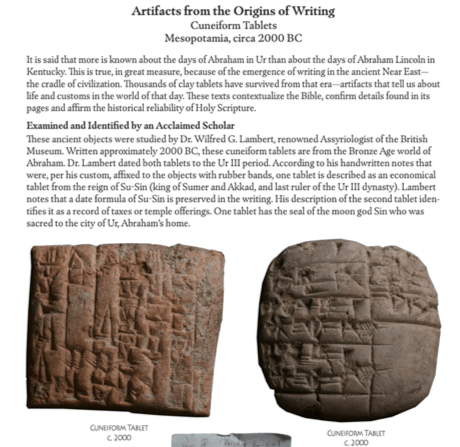
Screenshot of catalogue entry for cuneiform tablets

When flicking through the larger of the two brochures, my curiosity was captured immediately by two cuneiform tablets, placed under the inviting heading “Artifacts from the Origins of Writing.” Now I would like to preface this piece by noting that I am not an Assyriologist; I do not possess the required expertise to comment on the inscriptions of these tablets (for example, the first of the tablets appears to be orientated incorrectly, but I can’t be certain) nor their authenticity. Instead, I wish here to draw attention to the presentation of these two tablets.

After a few sentences highlighting very briefly the importance of cuneiform inscribed antiquities, the reader is informed that both of these tablets have supposedly been “Examined and Identified by an Acclaimed Scholar.” This reference to the involvement of an “Acclaimed Scholar” is a common trope in market parlance and offers problematic antiquities a façade of legitimacy. The association of an esteemed academic with antiquities offered for sale serves two functions. First, it implies that an object is authentic. Antiquities that have been looted, or otherwise removed from their archaeological context without any record, typically have no clear indicators that they are authentic. Associating such a piece with an academic suggests to a buyer that the antiquity must be authentic—after all, an “Acclaimed Scholar” has examined it. Secondly, the association of an academic with an object suggests it must be morally okay for someone to buy said object. Academics, by virtue of their profession, are viewed as trustworthy people. Thus, the logic suggests, if they were willing to interact with an antiquity, it must also be okay for a collector to purchase it.

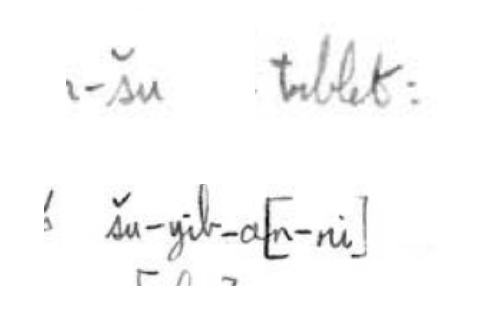
Interestingly, and perhaps unsurprisingly, the scholar said to have examined these tablets was none other than Wilfred Lambert (1926-2011). Lambert is rather notorious for his engagement with unprovenanced antiquities. Neil Brodie (2011, 129) has reported that almost two-thirds of the antiquities featuring cuneiform inscriptions—many of which were unprovenanced—that were offered for sale online in 2008 had been translated and authenticated by Lambert. Further, in an interview with the New York Times in 2003, Lambert conceded that, when authenticating objects for dealers, he does not “necessarily know where it comes from or how long it’s been coming.” There is, however, no real proof the Lambert ever actually examined these pieces. Within the catalogue the dealer includes a handwritten note, supposedly produced by Lambert, as evidence of Lambert’s involvement. However, there is no name, no signature, nor even a date on this note to support this claim (and establish that these pieces left their country of origin legally). This is not to say that Lambert did not examine these pieces, and his willingness to work with the market and his prolific output certainly make this a possibility, only that it is difficult to confirm the veracity of this claim. I would, however, like to draw attention here to the handwriting of the note. Following his death, eight of Lambert’s notebooks were scanned and made freely available online. The handwriting within these notebooks appears to differ rather significantly from what is found in the note supposedly also produced by Lambert. Perhaps most notably, the handwriting in the notebooks is largely cursive with multiple ligatures, while the handwriting of the note appears printed with very few ligatures or cursive characteristics. There are also serval distinct differences in the letterforms. Finally, and this perhaps may mean nothing, it is noted in the catalogue that the “handwritten notes that were, per his custom, affixed to the objects with rubber bands.” However, in the biography of Lambert, written by Andrew George (2015, 354), it is stated that Lambert’s estate “contained 10,000+ typewritten descriptions for dealers, many kept as very faded carbon copies” (emphasis mine). While I have been unable to investigate this further, this may suggest that when studying an object for someone else, Lambert tended to type, not write, his descriptions of the objects. It is possible that the dealer has confused Lambert’s tendency to produce hand drawn facsimiles of the tablets he worked on, although someone with more familiarity with Lambert’s work will be in a better position to comment here.

Noticeably, although unsurprisingly, absent in the description of the cuneiform tablets is any provenance (ownership history). This, of course, is problematic. Cuneiform objects are typically found in Iraq and following the Gulf War substantial quantities were looted from archaeological sites, or stolen from museums, and smuggled out of Iraq. Without provenance demonstrating these tablets left their country of origin legally, the prevailing assumption (assuming authenticity) must be that they were likely looted.

Finally, it is worth noting here that there are several factual mistakes in the description of these tablets. It is claimed that Lambert dated one tablet to the reign of “Su-Sin” (a variant spelling of Shu-Sin) who was the “king of Sumer and Akkad, and last ruler of the Ur III dynasty” (emphasis mine). This seems odd, here, given that Su-Sin, or Shu-Sin, was actually the penultimate ruler of the Ur III dynasty—a fact unlikely to have been forgotten by Lambert. Witt also claims that Lambert was a “renowned Assyriologist of the British Museum.” Although Lambert was indeed a “renowned Assyriologist,” and his research interests meant he was a frequent visitor of the museum (even contributing to the Museum’s catalogue of Near Eastern seals), he was not an employee of the British Museum as is implied here (the British Museum even features a short bibliography for Lambert, linked to the objects he donated, and there is no mention of him ever being an employee of the Museum. For more information about Lambert, see George’s biography). This reference to a famous institution like the British Museum, like referencing a famous scholar helps to further cement the supposed legitimacy and legality of the featured antiquities in the minds of potential buyers.

These two tablets are conspicuously absent from the second, smaller catalogue—which has been whittled down from 30 objects to seven. While it is unclear why exactly these objects have been removed, it is not unfair to assume they have been sold. After all, Wilfred Lambert is still listed as one of the “Prominent Scholars Who Have Examined and Studied Items in this Collection” on the back page. If these tablets have indeed been purchased, then one hopes their owner did not fall for the clichéd ‘market speak’ found throughout this listing and performed their due diligence. Unfortunately, however, history has shown us that this is unlikely, and until evidence is provided to the contrary these tablets are (to put it lightly) problematic.

Richard Bott

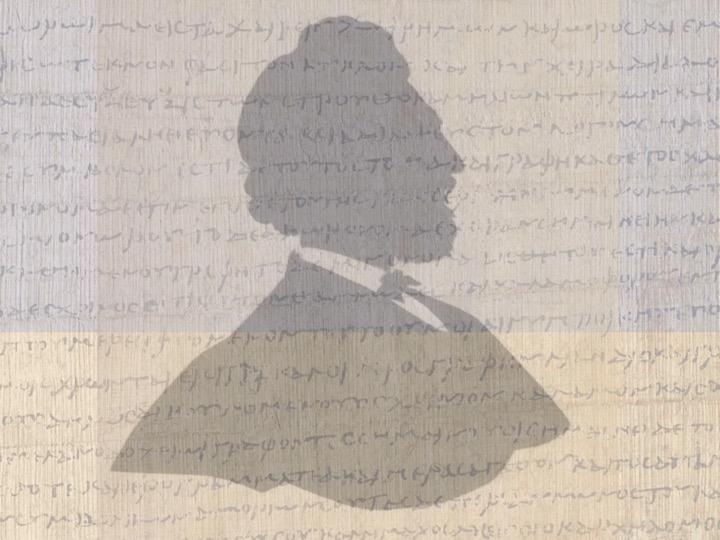
Malcolm Choat, ‘A Forger, his models, methods, and motives: The papyri of Constantine Simonides’: FORVM ANTIKE seminar

On Wednesday 9th December, at 7 pm Australian Eastern Daylight time (Sydney) = 9 am Central European time (Vienna) = 8 am GMT (London) = 10 am Egypt (and very early morning in the US and Canada…) Malcolm Choat will give a paper in the FORVM ANTIKE online seminar series hosted by the Department of Ancient History and the Department of Numismatics at the University of Vienna, on the topic ‘A Forger, his models, methods, and motives: The papyri of Constantine Simonides’.

This online paper will be hosted on the Collaborate platform, and the session may be joined at this link. Please join us online to hear about the Forging Antiquity team’s latest research on Simonides and his papyri!

Mareile Pfannebecker: “Malemployed Desire: online work and play under digital capitalism”

This Tuesday, 24 November, 2020, we invite you to a special online talk hosted by Markers of Authenticity and the Platform Intimacies Research Initiative through the Faculty of Arts, Macquarie University, by Dr Mariele Pfannebecker, from Manchester.

Her paper will discuss how digitally managed desire structures the lives we lead working and not working online. In her talk, she wants to look at how forms of online posting that blur the line between work and play – like that of internet celebrity – function paradigmatically to show how the material and psychological structure of employment is changing in ways that affect all workers. Second, she’ll discuss how internet platforms’ algorithmic putting to work of what we want, from search engines to social media, suffers from a pre-Freudian theory of desire that fails to anticipate the effects of a digitalised pleasure principle.

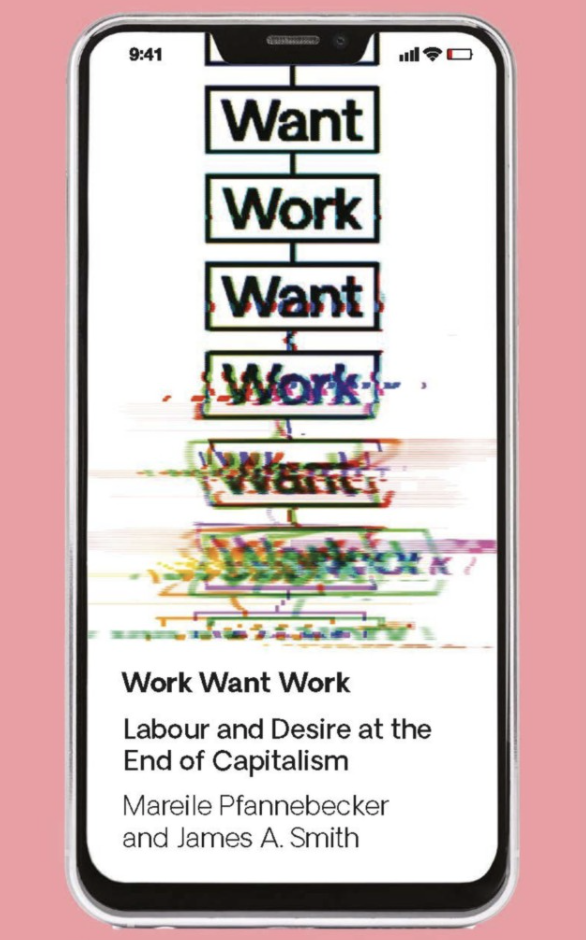
This paper will draw on ideas from Mareile and James Smith’s book, Work Want Work: Labour and Desire at the End of Capitalism (Zed, 2020).

The talk will be moderated by Dr Chris Muller from the Department of Media, Communications, Creative Arts, Literature and Language.

Join us via zoom:

Tuesday 24th of November, 2020, 19:30 (Sydney) / 8:30 (UK) / 9:30 (CET) https://macquarie.zoom.us/j/87806525457pwd=UVBXVjJwVzU2cThsL0crMFovb1dOUT09 Password: 686581

2019 Interns on the Forging Antiquity Project

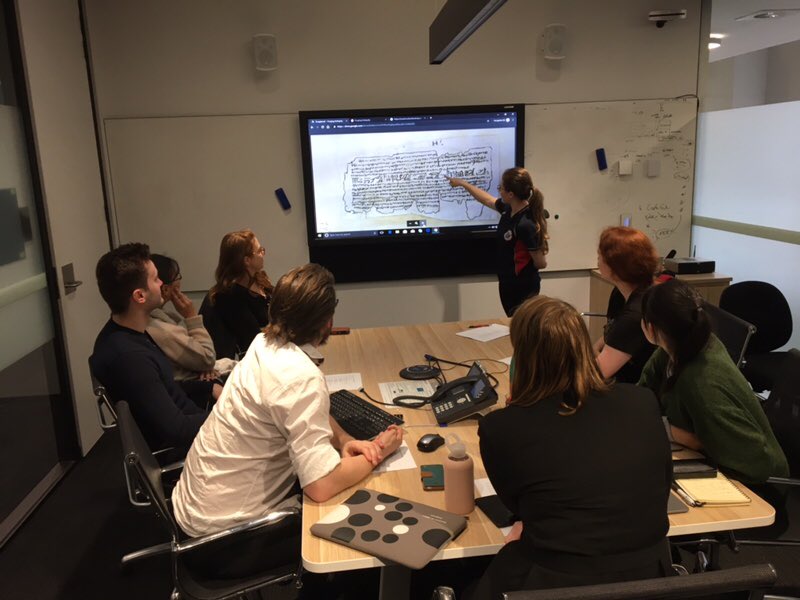
In the second semester of 2019, the Forging Antiquity team were joined by a number of undergraduate interns working on a range of topics from the early history of scientific testing through to the range of ethics policies related to antiquities in place at Australian institutions today.

Team

Two of our interns have subsequently joined the Forging Antiquities team (Evie Handby and George Topalidis as MRes thesis candidate and Research Assistant respectively).

Fake Jewish and Christian Manuscripts – Evie Handby

Screen Shot 2020-07-30 at 11.24.27 am

I’m currently completing a Master of Research in the Department of Ancient History. My research interests focus on the reception history of the Hebrew Bible and the intersection of social media and the illicit antiquities trade.

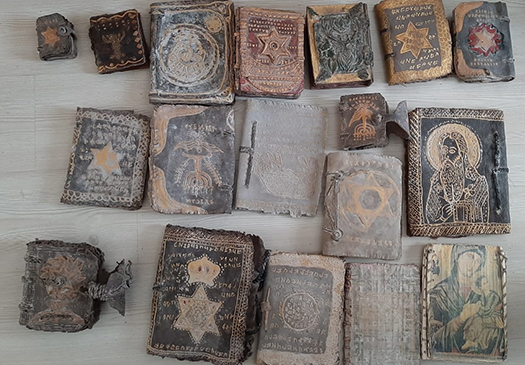
In 2019, I interned with Forging Antiquity on a project that sought to examine how a series of fake Jewish and Christian manuscripts surfacing in Turkey are represented in the news media.

eser(1)
Seizure of Fake Bibles from Ankara, January, 2020. Source: Kılıç, R. (2020). “Jandarma alıcı kılığına girdi, 6 tarihi eser kaçakçısı yakalandı”. TRT Haber, 15 January. 

The nature of this project meant that I was able to develop and strengthen a variety of Internet research skills, especially those relating to the collection, analysis, and dissemination of open source data. As an extension of this project, the aim of my Master’s thesis is to explore further the relationship between social media and the illicit antiquities trade by investigating how the manuscripts are advertised and sold on YouTube.


Konstantine Simonides in his own words  – George Topalidis

thumbnail_IMG-3428I am a second-year Masters of Research student in Macquarie University’s Department of Ancient History. My fields of interest include ancient Greek religion and the Greek language both ancient and modern.
One of the projects of my internship included translating the writings of the elusive Konstantinos Simonides, a notorious Greek forger of the 19th century. My primary focus was on Simonides’ letter to the fictitious monk Kallinikos, purporting to demonstrate the ‘correct’ reading of Egyptian hieroglyphs in opposition to that of Champollion. Throughout this year, I have the privilege of continuing my work on Simonides as a Research Assistant, transcribing and translating the letters between him and his once good friend John Eliot Hodgkin.

In translating Simonides’ writings – both his forgeries and personal letters – I became intimately familiar with the aims and authenticating techniques of a forger. Simonides frequently employed forged ‘ancient’ authorities to enforce the authenticity of his arguments, while at the same time attempted to de-authenticate his opponents. Through his writings, it became clear to me that authenticity and the struggle to present oneself – or something else – as authentic lie at the heart of issues regarding forgeries, cultural heritage, and the reconstruction of the past. I hope that my work will contribute to the greater discourse surrounding authenticity, and bring focus upon Simonides’ work within the context of 19th century Greek history and identity.

Markers of Authenticity in 2019

Having run some 12 events, including a major international conference and a showcase event in 2018, and feeling at once somewhat burnt out and that we were not making enough time for research and writing, the Markers of Authenticity team pulled back a little in 2019, restricting ourselves to three seminars and an event showcasing our own research, all of which were generously sponsored by the newly inaugurated Macquarie University Centre for Ancient Cultural Heritage and the Environment. The slimmer program of events notwithstanding, we were nevertheless pleased with what we were able to put on, which focussed as always on putting representatives of different disciplines in dialogue around the themes of the research stream.

MemoryImageIn our opening seminar for the year, we asked how collaborative memory works in practice, inviting family historian A/Prof. Tanya Evans to talk about her research on family historians’ work with memory, and educational psychologist A/Prof. Penny van Bergen to discuss her work how showing how reminiscing with mothers and others supports young children’s memory and emotional development. We were overjoyed that bringing these two researchers into dialogue resulted in a new collaborative research project between them, and look forward to hearing about the results of that work in the future.
In May we asked Renaissance historian Dr Nic Baker, and Dr John Selby, an expert onRiskImage technology and internet fraud from the Macquarie Business School, to discuss the
Authenticity of Risk. From them we learned about financial speculation in sixteenth century Italy, through the lens of diverse attitudes to gambling, and the threats posed to authentic online interactions by cyber crime.

In August, we held our final seminar in the regular series, in which we were privileged to be able to host Dr Crystal Abidin from Curtin University, who spoke with A/Prof. Hsu-Ming Teo, Head of English at Macquarie, on Authentic Selves. In this fascinating seminar Dr Abidin talked us through her work on Asian online influencers, from ‘calibrated amateurism’ to ‘porous authenticity’, while SelfDraftA/Prof. Teo gave us a preview of forthcoming work on the ways in which the cultural authenticity of Asian families is constructed in romance novels. The 40-strong audience spoke to the pulling power of the speakers and the research on display, and Dr Abidin generously made time to talk to ECRs and students in the team.
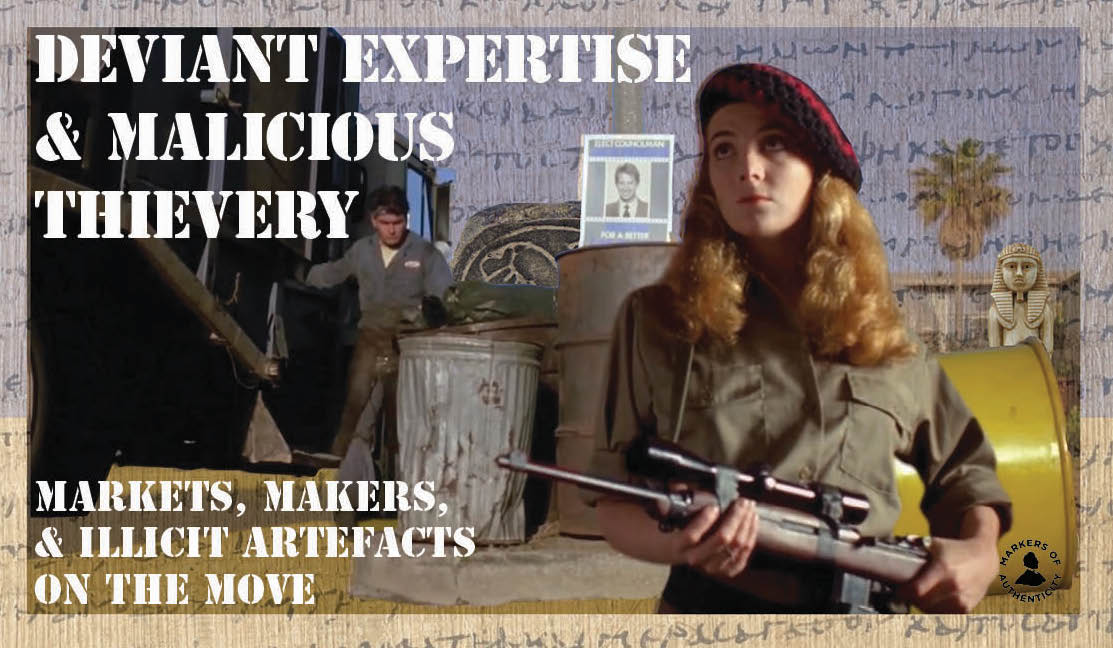
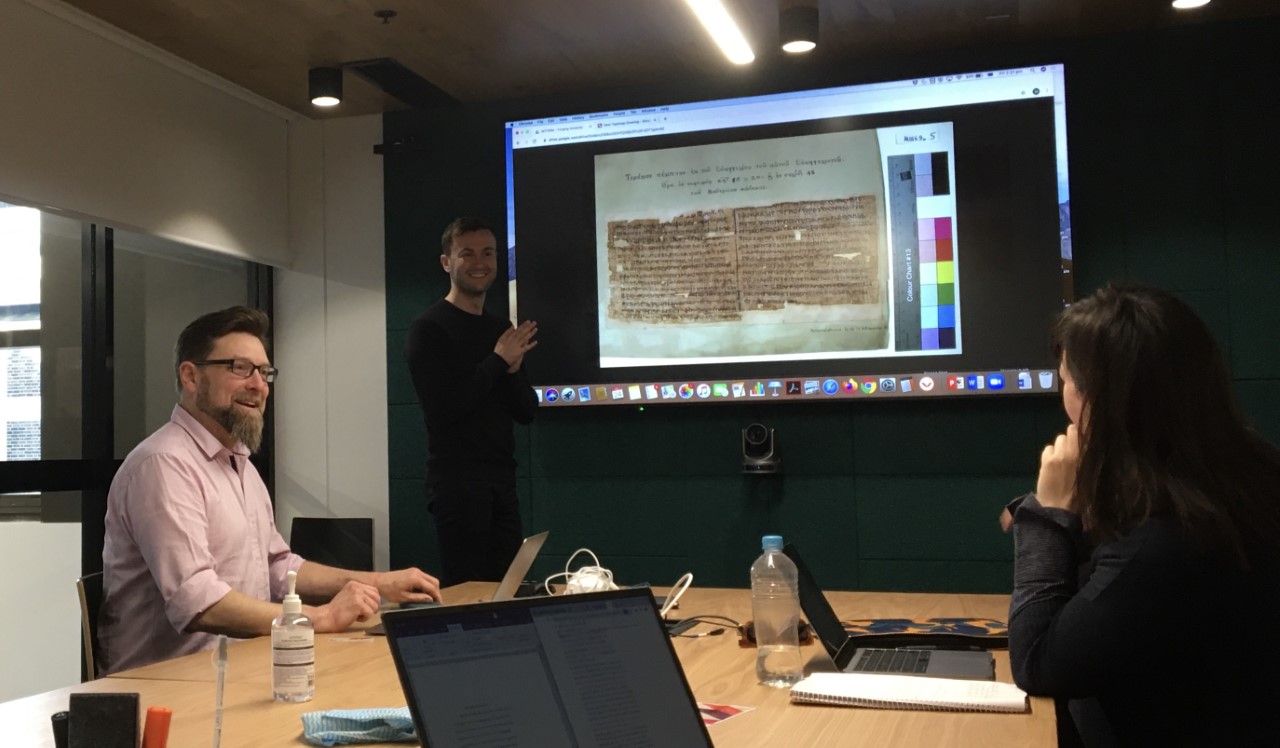
For our final event of the year, the team working on the ARC funded project ‘Forging Antiquity’ held a afternoon seminar entitled ‘Deviant Expertise and Malicious Thievery’ to showcase their research in the project to date. Graduate students, project staff, and student interns talked an audience of c. 50 people though their findings on forgery, ethics, and provenance in papers and posters.

PosterShowcase2019

Along the way in 2019, the Forging Antiquity project hosted five student interns in the second half of the year, who worked on a diverse set of topics related to the ARC funded projects under the team’s aegis. They all did fantastic work, some of which we’llTeam showcase further in the future. We were very pleased that Evie Handby, who undertook an internship collecting information on the fake Hebrew and Syriac bibles which have been showing up in Turkey during the last decade, will start a Masters of Research thesis on this topic in 2020.

During the year, Markers of Authenticity was also renewed as a Faculty of Arts Research Stream at Macquarie University, and will soon have an internet presence on the Faculty’s research pages. We look forward to taking part in the program of events to mark the opening of Macquarie new Arts precinct in 2020, in what will be the fifth year of the seminar. Best wishes from us all for a happy new year, and see your in 2020!

The Markers of Authenticity team

Authentic Selves

For our third Markers of Authenticity seminar for 2019, we’re going to consider the ways in which the self is projected, constructed, and created,  from internet culture to literature. Join us on Friday 30th August, 4–6pm, for an interdisciplinary seminar sponsored by the Centre for Ancient Cultural Heritage and the Environment in the Australian Hearing Hub, Level 3, Rm 202 (the ‘Recreation room’: note change from usual venue).

SelfDraft

Influencers and Cultures of Authenticity-making

Dr Crystal Abidin, Senior Research Fellow & ARC DECRA Fellow in Internet Studies, Curtin University / Affiliate Researcher with the Media Management and Transformation Centre, Jönköping University.

In the earliest days of Influencer commerce, the allure was premised on the diary-like reportage of people’s everyday lives, in the rhetoric of confessional documentaries. The regularity and frequency of their updates mirrored the daily rhythms of a teenager’s social life and attracted followers: Their blogs became a means for other girls to learn how to be social through consumption, within their modest spending power. Today, these pioneers are among the most seasoned veterans in influencer culture, innovating with new disclosure strategies to sustain followers over their decade-long careers. Drawing from research on regional Influencer cultures since 2008, in this seminar I will provide a brief overview of the concepts ‘Perceived interconnectedness’, ‘Relatability’, ‘Calibrated amateurism’, and ‘Porous authenticity’ for discussion in relation to cultures of authenticity-making.

Cultural Authenticity, the Family, and East Asian Romance Novels

Associate Professor Hsu-Ming Teo, Department of English, Macquarie University.

In 2018 the film Crazy Rich Asians was released to much fanfare and publicity, earning nominations at the Golden Globes and other awards, and grossing $174,532,921 in the United States and $238,532,921 worldwide. Although criticized within Asian markets, especially in Singapore, for its erasure of non-ethnically Chinese characters from the romantic comedy, Crazy Rich Asians was lauded in the US for its all-Asian cast – something seldom seen in Hollywood. Romance stories featuring Asian protagonists are still few and far between, leading writers, readers, and bloggers with an Asian background to establish websites that compile lists of Asian-themed romances, as well as frustrated blogs that ask “Are Asian Men Not Sexy?” and “Where the Hell Are All the Asians?”.

The demand by bloggers and readers on such websites for “sexy Asians” raises an intriguing question: what exactly is it about a romance novel that makes it “Asian”? Protagonists who are from the dizzying diversity of “Asian” backgrounds? Is “Asianness” a term from race or the process of racialization? Or ethnic variations within a racialized category? Or do national origins – Singapore, Hong Kong, Taiwan, the People’s Republic of China, Thailand, South Korea, India, the Philippines, and so on – contribute more to particular types of Asianness? And what about Asian-American romances – the most substantial contemporary genre in which protagonists of Asian backgrounds are currently found. Are fully assimilated American romantic protagonists of Asian background, who wear their cultural difference lightly and whose Asianness is virtually invisible, sufficient to make a romance Asian? Or must Asian difference be emphasized no matter how many generations the Asian-American protagonist’s family has been in the United States?

This paper considers how Asianness is created as an example of Gayatri Spivak’s “strategic essentialism”, and through strategies of what Stanley Fish calls “strong” and “weak” multiculturalism. It looks at how history, culture, and, above all, a certain notion of the oppressive Asian family are used to create a sense of authentic Asianness in the contemporary romance genre.

Authenticity of Risk

For our second Markers of Authenticity seminar for 2019, we’ll turn our attention to the concept of risk and how risk is made meaningful to us from Renaissance Italy through to the cyber security frontlines of today. Join us on Friday 24th May, 4–6pm, for a cross-faculty seminar sponsored by the Centre for Ancient Cultural Heritage and the Environment in the Australian Hearing Hub, Level 5, Rm 212.

How Unknown was the Unknown Future? Cheats and Frauds in Renaissance Italy

Dr Nicholas Baker, Department of Modern History, Politics and International Relations.

According to the sixteenth-century Church, gambling was problematic because it was immoral and sinful; but according to most other Renaissance sources the real problem with gambling was not metaphysical but rather the fact that  frequently the odds were not equal but rigged through deception, fraud, or cheating. I will reflect on how sixteenth-century Italians thought about risk in relation to financial speculation on apparently unknown future outcomes.

Trust, Authenticity and Cybersecurity Risks

Dr John Selby, Department of Accounting and Corporate Governance

Since the widespread adoption of the Internet in the 1990s, government, businesses and society have all become exposed to significant and growing cybersecurity risks which undermine our concepts of trust and authenticity. Cyber-criminals have sought to exploit our trust in other humans so as to steal money through a variety of scams, such as romance fraud, phishing, whaling and business email compromises. Businesses have sought to exploit our desire for “free” services and authentic social interactions so as to engage in surveillance capitalism. Governments have struggled to accurately identify these criminal attackers, creating an attribution problem which threatens the viability of the cyber-insurance industry. This presentation will give a very brief introduction to these complex problems with the goal of stimulating an interdisciplinary discussion of how we might better study, understand and solve them.

Authenticity of Memory

For our first Markers of Authenticity seminar for 2019, we’ll be considering how collaborative memory works in practice. Join us on Friday 12th April 4–6 pm for a special seminar presented in conjunction with the Centre for Applied History and sponsored by the Centre for Ancient Cultural Heritage and the Environment in the Australian Hearing Hub, Level 5, Rm 212.

MemoryImage

How do family historians work with memory?

A/Prof. Tanya Evans (Department of Modern History, Politics, and International Relations, Macquarie University; Director, Centre for Applied History)

Drawing on survey data and oral history interviews undertaken with family historians in Australia, England and Canada this talk will explore the ways in which family historians construct memories using diverse sources in their research. It will show how they utilise oral history, archival documents, material culture and explorations of space to construct and reconstruct family stories and to make meaning of the past. It will ask whether they undertake critical readings of these sources when piecing together their families’ stories and reveal the impact of that work on individual subjectivities, the construction of historical consciousness and the broader social value of family history scholarship. Global family history challenges the patriarchal, nation-focussed, state-driven historical scholarship we discover so easily in our formal archives and libraries. How might family historians reshape our knowledge on memory and the history of the family in the 21st century?

“Remember when…?” How reminiscing with mothers and others supports young children’s memory and emotion development

A/Prof. Penny Van Bergen (SFHEA, Department of Educational Studies, Macquarie University; Director, Centre for Children’s Learning in a Social World)

Memory is a critically important aspect of our lives. We share memories with one another multiple times a day: building emotional bonds, eliciting sympathy or empathy, and problem solving for the future. As parents and teachers, we also scaffold and support young children’s emerging memory narratives. I extend on this past research in two ways. First, I consider implications for emotion development. I show how reminiscing about emotional past events (e.g. fights with friends, getting in trouble) may be a particularly rich forum for developing emotion competence. Next, I extend from mothers to others. Working with teachers, fathers, and other children, I show how a range of socialising agents support children’s memory.