
Version 1 of the Forging Antiquity database was published online in 2019. It contained 214 records of forged papyri, and had been largely complied by Malcolm Choat, Rachel Yuen-Collingridge, and Vanessa Mawby as part of the first phase of the project. That was a long time ago, and the database has grown considerably since that time: it’s time to bring Version 2 online.
Since 2019, a number of project interns and research assistants have contributed to this dataset in various ways, including Levi Bak and Brooke Gallucci. Notably, the 2019 version served as the starting point for Richard Bott’s PhD research into the history of collecting forged papyri, which substantially expanded the number of forgeries known to the project, to the point where Version 2 of the database now lists 561 forged papyri.
Although we focus in the project on papyri in the narrow sense, the database includes anything from – or allegedly from – Egypt, traditionally covered by the discipline of papyrology: this is basically moveable objects written with ink, and excludes objects carved or inscribed, or on immoveable (or at least less moveable) objects. Specifically, inscriptions, graffiti, and dipinti are not included. But at the risk of inconsistency, mummy labels and culturally adjacent artefacts are included, alongside a number of other sui generis items.
This version incorporates our latest typology of forged papyri. Previous typologies of forged papyri classified them into three broad categories: those written in pseudoscripts; composites made by joining parts of multiple original texts; and those which made textual sense, either copied or composed. We felt this schema introduced category errors, and have proposed a faceted typology which classifies forgeries in terms of their material support, use, script, and content, to attempt to capture what the text is written on; whether or not it is reused; what type of script is employed; and what the content is.
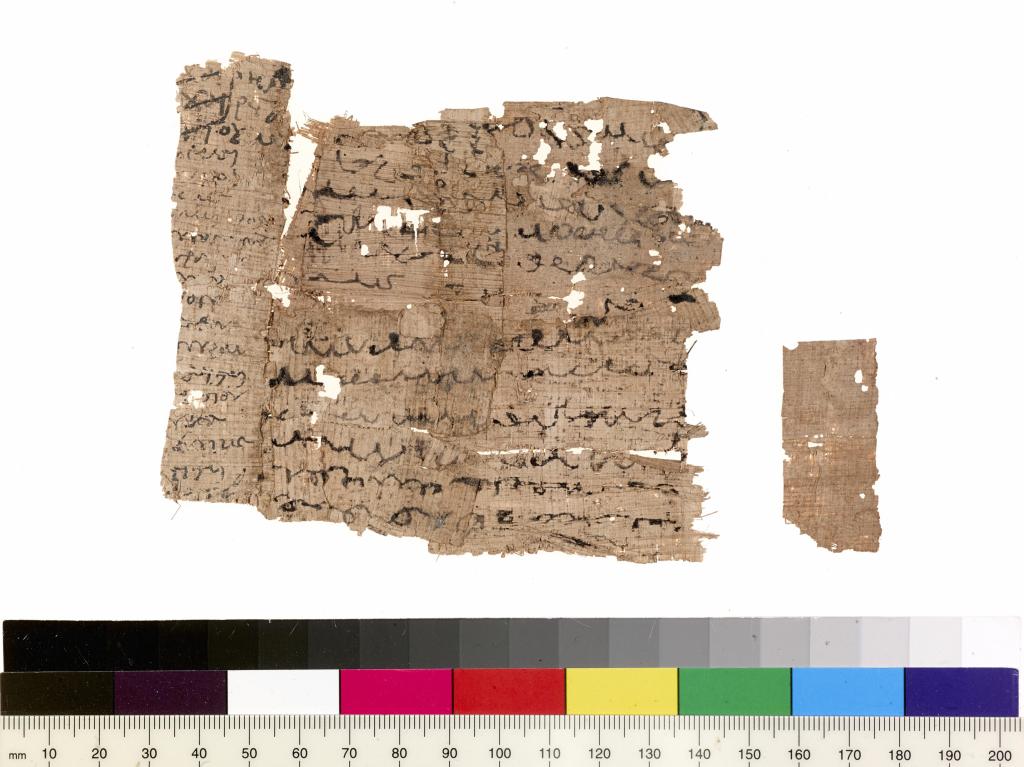
Of the 561 records, 292 are objects which use papyrus in some way. Of these, 14 are fake composite rolls which use wood or textile to create a facsimile of a roll, and three are fake “stelae” created by gluing papyrus onto wood. Of the 272 comprised only of papyrus, 147 use a simulated or adapted alphabet, and feature a script either imagined by the forger, or letters from a known script arranged in a nonsensical manner. These are the most common type of forgery captured by the database and represent around 50% of the entries. The majority of these forgeries were acquired in the late 19th and early 20th centuries, and were usually acquired as part of the mass purchases that were typical of the time (Bott 2024; cf. Choat 2019, 563). While many of these nonsensical forgeries are easy to identify in isolation, some can be more difficult.
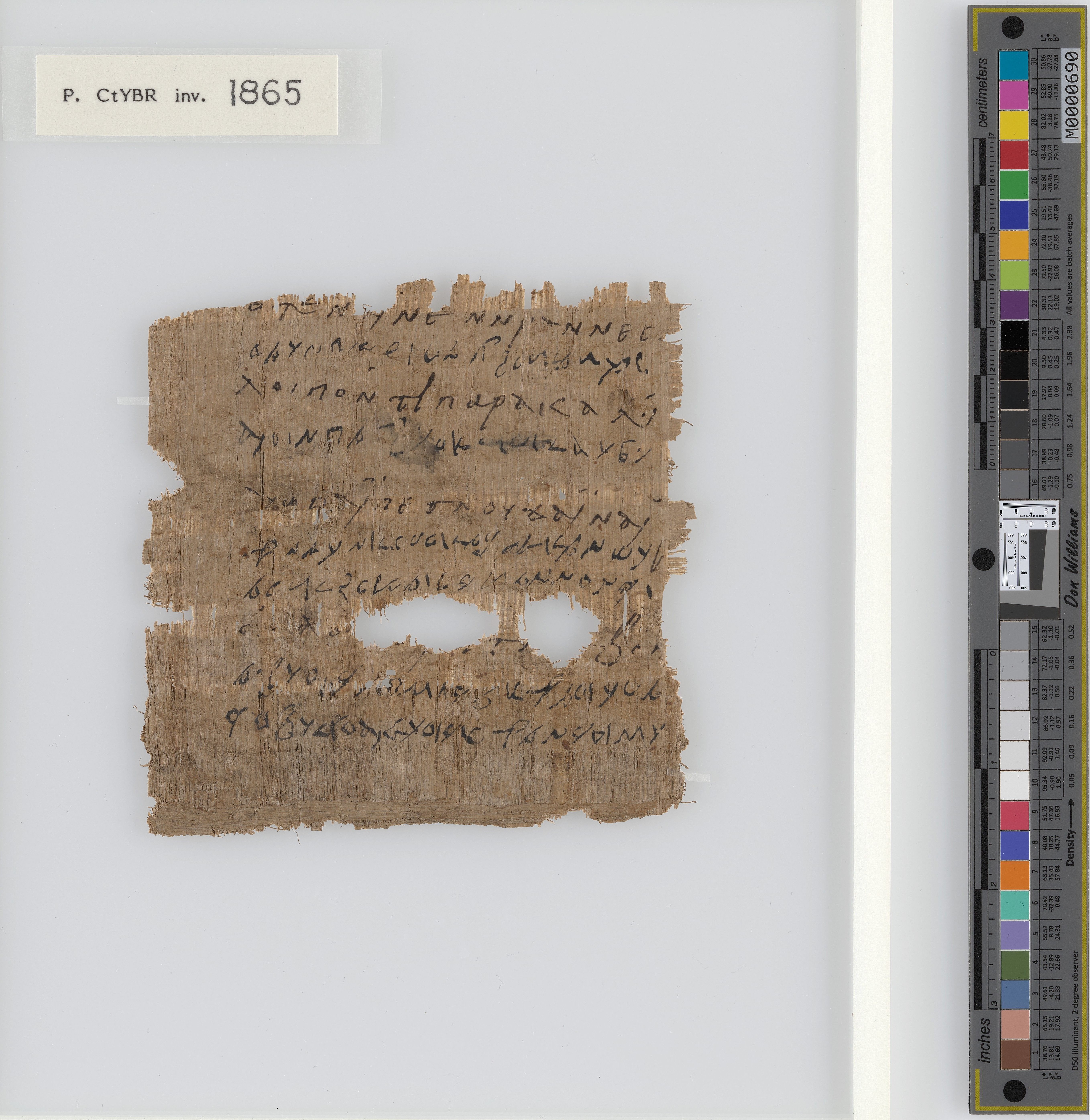
P.CtYBR.inv. 1865 in the Yale Collection provides an apposite example. This somewhat square papyrus contains three-to-four lines of authentic Coptic (two large lacunae have made one line almost unreadable), with some nonsensical text in a simulated script added between and below the original text. As such, one could be forgiven for overlooking this as a forgery or dismissing the entire piece as a forgery as a result ofthe added forged text (as Theodore Petersen did in the original sales catalogue).
A little over a quarter of the entries in the database feature text copied from authentic models. While some of these, including several of the forgeries of Constantine Simonides, are complex copies with adaptations to the text made, most are relatively simple texts. Authentic mummy labels (or tags) are the most frequent model type, probably as a result of the usually short and clear text. Their prevalence in the data set accounts for wood being the most prolific writing support after papyrus (110 records).
Forgers often produced multiple forged mummy labels, which meant a text could be sold multiple times. One such instance that came to light while working on this database has a forger working at least in triplicate (and there is at least one case where a forger appears to have worked in quadruplicate). In their 2014 article, Clarysse, Maitland, and Worp published a fake mummy label from the NMS collection in Edinburgh (T.Edinburgh NMS A.1921.896). As they note, this label is a copy of one in the Bibliothèque Nationale in Paris (Cabinet des Médailles, inv. 1125 (SB 20.14413)), with several transcription errors made by the forger confirming the inauthenticity of the NMS label (i.e. a lost β, a misreading of the relationship between a τ and ε). These same distinctive errors are present across the other two located forgeries (T.Mom.Louvre E34971;T.Mom.Louvre E34965), both in the Louvre, suggesting all three are the product of a single forger. Following Clarysse et al. (2014), and given there is no acquisition information available for the Louvre pieces, this relationship allows us to suggest that the Louvre pieces were probably produced in the mid-to-late 19th century as the Bibliothèque Nationale’s authentic model was originally acquired in 1889.
While few forgers can be identified, at times we can plausibly identify the work of a single forger. María Jesús Albarrán Martínez has located several related composite support and text forgeries in the Palau-Ribes Collection in Barcelona (Albarrán Martínez 2023: P.PalauRib.Glutinata.1–5). These forgeries were acquired in the 1960s, were well-made with some degree of care taken when assembling the various fragments to give the illusion of a larger complete text, and then fragments include internal evidence that suggests they were found in or around Bawit. On this basis, Albarrán Martínez suggested they were likely the product of a single forger or workshop that had direct access to material being looted from Bawit in the mid-20th century. While a few other examples have come to light in other collections (i.e. PUG. 5.225), provenance (collection histories) information collected for several of the forgeries listed in the database suggests that this (unknown) forger may been rather prolific. In the mid-1960s, the Yale Collection, through Beinecke, purchased a collection of papyri from the bookseller Hans Kraus, which included 20 forgeries. While some were nonsense script pieces, most of these forgeries were composite support and text forgeries. Although these have now been disassembled, when the original sales catalogue is consulted, it becomes clear that these pieces were originally sold as composite works. For example, the description for no. 31 in the Kraus catalogue reads as follows: “This papyrus is pasted together of 12 small pieces from 5 or 6 different documents; 6 of them are upside down. One of the pieces reveals the name of the Monastery of Apa Apollo.” A number of similar examples are found throughout the catalogue. While it is difficult to say for certain that these belong to the corpus identified by Albarrán Martínez, especially since we do not have images of these forgeries before being disassembled, the possibility that we may be able to tie these pieces to a single forger is an exciting thought.
We hope making a new version of the database public will enable further such connections to be drawn, and look forward to seeing uses to which it is put.
Richard Bott, Rachel Yuen-Collingridge, and Malcolm Choat.

